When it comes to Facebook algorithms, the rules are constantly changing. And with the advent of new social media platforms seemingly almost every day, it can be hard to know all the rules, much less follow them.
There are two things to say right up front:
- Facebook (and most platforms) favor visual content–especially if that visual content is dynamic (eg, not a static image).
- Your visual element is what will get the reader’s attention–but text is where you can do some pretty hardcore convincing.
And to write copy that sells, traditional rules still stand. Tried-and-true formulas of advertising been around for decades, if not centuries, for a reason.
You need:
- A headline that converts. Ideally this should be in the form of an incredible promise.
- Post text that supports your headline, if applicable to your ad type. Be specific. Use statistics or data if you can. Consumers are savvier than ever, and they want facts. Not clickbait.
- A call-to action. This could be anything from offering a free download to directing to your landing page. If you are directing to a landing page, remember to coordinate the content there to create a seamless experience for your user. The first thing they see should accent the last thing they saw on your ad.
Now that you know the basics, see if you can identify the promise, the data, and the call-to-action in the following FB ads.
Anatomy of a Facebook Ad #1: Asana
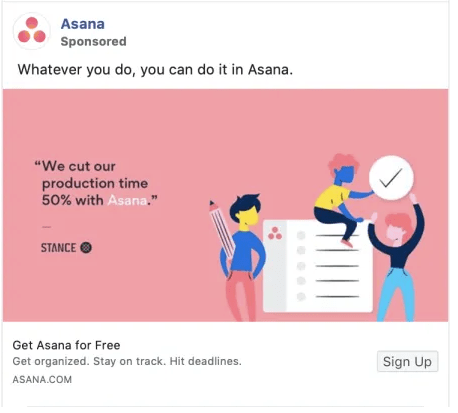
Asana makes a lot of powerful promises in this ad. You can do anything in Asana. Asana will cut your production time by 50%.
Notice that specific “50%” number? If they had simply said “cut your production time” it wouldn’t have been nearly as powerful. Add to it the social proof–they use a testimonial, another source, to tell you, “Hey we aren’t bragging about ourselves. These other people are bragging about us.”
Finally, there’s the call-to-action. There are two here: The simple “Sign Up” button but, more powerfully, the “Get Asana for Free” which uses one of the most highly-converting words in the English language despite being overly used.
Anatomy of a Facebook Ad #2: Doordash
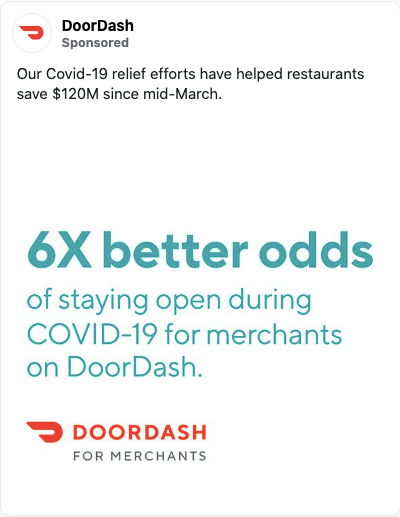
Doordash really hits on a pain point for restaurant owners in this ad–if you are afraid of closing up shop in the middle of the Covid-19 pandemic this ad is going to catch your eye. It uses a hard number with 6x — what restaurant owner wouldn’t want to have 6x better chance of keeping their restaurant open?
The ad is a reminder of speaking to your audience, as well as Facebook’s powerful targeting capabilities. If you have multiple audiences, you will need to tailor your copy to that audience. This could be as simple as those who are repeat customers vs. those who are new customers. How you talk to them will be incredibly different.
And with this Doordash? Unless you are a restaurant owner, you will likely never see this ad.
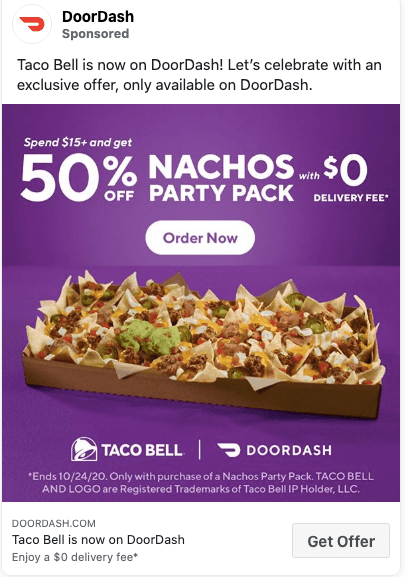
As a consumer, you’ll see this ad:
And if they are targeting you as someone looking for a job? Perhaps you will see this ad:

But in all three ads, serving three different audiences, can you still see the promise, the statistic, and the call-to-action?
Once you see it, you will never be able to un-see it in any commercial or advertisement you see.
 Stefanie Cosman